
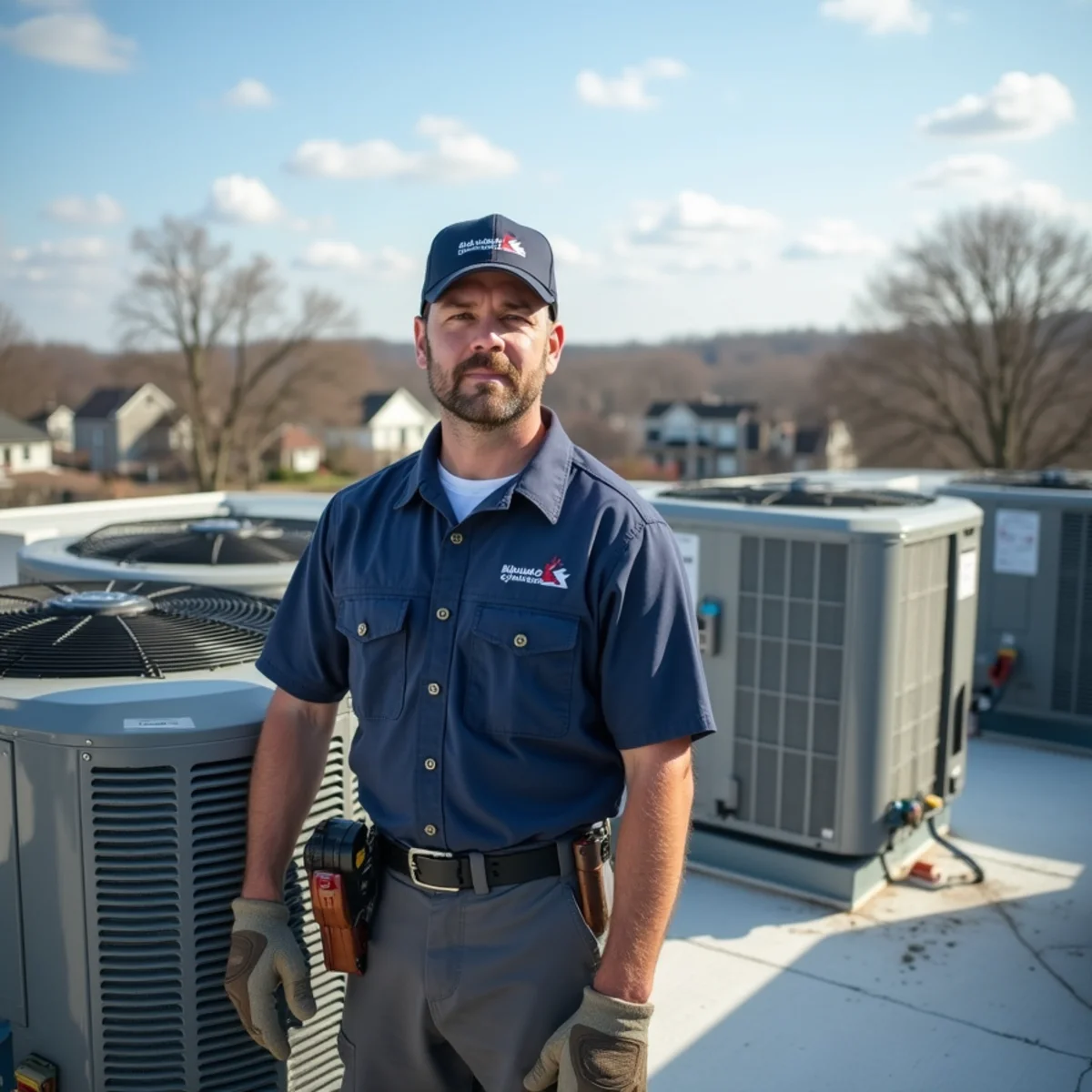
The rooftop units running the stores and offices along Route 300 and 17K fail the same way for the same reasons. A scheduled maintenance program is how you stop paying for it in downtime.
The commercial corridors that ring Newburgh, Route 300, 17K, Union Avenue, South Plank Road, run on rooftop package units, the big metal boxes you never think about until the sales floor hits 82 degrees on a Saturday. For a business, a dead RTU is not a comfort problem. It is lost sales, spoiled inventory, uncomfortable tenants, and an emergency bill that dwarfs what prevention would have cost. The units clustered around Gardnertown and the retail strips fail in predictable ways, and predictable failures are preventable ones.
Why rooftop units fail early
Rooftop equipment lives in the harshest spot on the property. It bakes in summer sun, freezes in Hudson Valley winters, and sits directly in the path of every leaf, seed, and bit of grit the wind carries. Out of sight, it gets ignored until it quits.
- Clogged condenser coils from airborne debris kill efficiency and lead to compressor failure, the most expensive repair on the unit.
- Neglected filters choke airflow and freeze coils, shutting the system down on the busiest days.
- Worn belts and bearings on larger units snap without warning and take the whole unit offline.
- Failed economizers and stuck dampers quietly waste energy for months before anyone notices the bill.
- Blocked condensate drains overflow and cause roof and ceiling leaks inside the building.
What a commercial maintenance program covers
The point of a program is to catch each of those failures before it happens, on a schedule tied to how hard the equipment works. A well-run commercial HVAC maintenance plan usually runs quarterly for busy sites and covers the full unit.
- 1
Coil and filter service
Clean condenser and evaporator coils and replace filters so the unit moves air efficiently and the compressor is not fighting a dirty coil.
- 2
Belts, bearings, and motors
Inspect and adjust belts, lubricate bearings, and check motor amp draw so mechanical parts do not fail mid-season.
- 3
Refrigerant and electrical check
Verify refrigerant charge, tighten electrical connections, and test contactors and capacitors, the small parts that cause most no-cool calls.
- 4
Controls, economizer, and drains
Confirm the thermostat and economizer work, dampers move freely, and condensate drains are clear so you are not wasting energy or leaking into the ceiling.
Ask for a documented report each visit
A good commercial vendor leaves you a written report of what was checked, what was fixed, and what is trending toward failure. That paper trail helps you budget capital replacements before they become emergencies, and it is invaluable for property managers juggling multiple buildings.
The math a business owner cares about
Maintenance is not about being tidy. It is about three numbers: downtime, energy, and equipment life. A single emergency failure during business hours can cost more than a full year of maintenance once you count lost revenue and after-hours rates. A dirty, neglected unit can burn 20 to 30 percent more energy than a clean one. And a maintained rooftop unit often lasts several years longer than one run to failure, pushing off a five-figure replacement. For businesses along the Route 300 corridor near Gardnertown, those numbers add up fast across a fleet of units.
Getting ahead of the seasons
Schedule cooling-side service in early spring and heating-side service in early fall, so each system is proven before its peak demand. If you run multiple properties or a mix of rooftop units and interior systems, a single maintenance contract with one accountable vendor beats chasing separate service calls. Our team maintains commercial sites across Newburgh and the greater Orange County market, and we build the schedule around your business hours, not ours.
The hidden cost of run-it-till-it-breaks
Plenty of businesses treat rooftop units as invisible until they fail, and on paper that feels like saving money. In practice it is the most expensive way to run equipment. A neglected unit burns more energy every single month, so you are quietly overpaying on the utility bill long before anything breaks. When it does fail, it fails on the hottest or coldest day, at after-hours emergency rates, often taking out a costly component that regular service would have caught while it was a cheap part. And the whole time, comfort complaints from customers and staff are costing you in ways that never show up on an invoice.
One more piece owners appreciate: a maintained fleet is predictable to budget. When a vendor tracks the age and condition of every unit and flags the ones trending toward replacement, you can plan a capital expense for the off-season instead of writing an emergency check in July. Predictability is worth real money to a facility manager juggling several properties.
Match the plan to how the space is used
A restaurant kitchen with grease-laden air fouls coils and filters far faster than a quiet office suite, and a warehouse with big roll-up doors fights a different battle than a retail floor. Good commercial maintenance is not one-size-fits-all. The visit frequency and scope should track how hard each unit actually works, which is why we walk the roof and the floor before quoting a program rather than pricing off unit count alone.
Stop paying for downtime
Set up a rooftop maintenance program tailored to your building along Route 300, 17K, or Union Ave. Call HVAC Newburgh NY at +1 (327) 210-5999.
HVAC Newburgh NY · 48 Carter St, Newburgh, NY 12550
Scheduled maintenance vs run-it-till-it-breaks
| Factor | With a maintenance program | Run-to-failure |
|---|---|---|
| Energy use | Runs at rated efficiency | 20–30% more on a dirty, neglected unit |
| Downtime | Rare and planned | Fails on the busiest days at after-hours rates |
| Equipment life | Often several years longer | Shortened by neglect |
| Compressor risk | Condenser coil kept clean | Overheats and fails — the costliest repair |
| Budgeting | Plan capital in the off-season | Emergency five-figure checks |
Frequently asked
Most busy Newburgh sites do best on a quarterly program, with heavier cooling service in spring and heating service in fall. High-runtime restaurants and retail may need more frequent filter and coil attention. The schedule should match how hard the equipment actually works.