
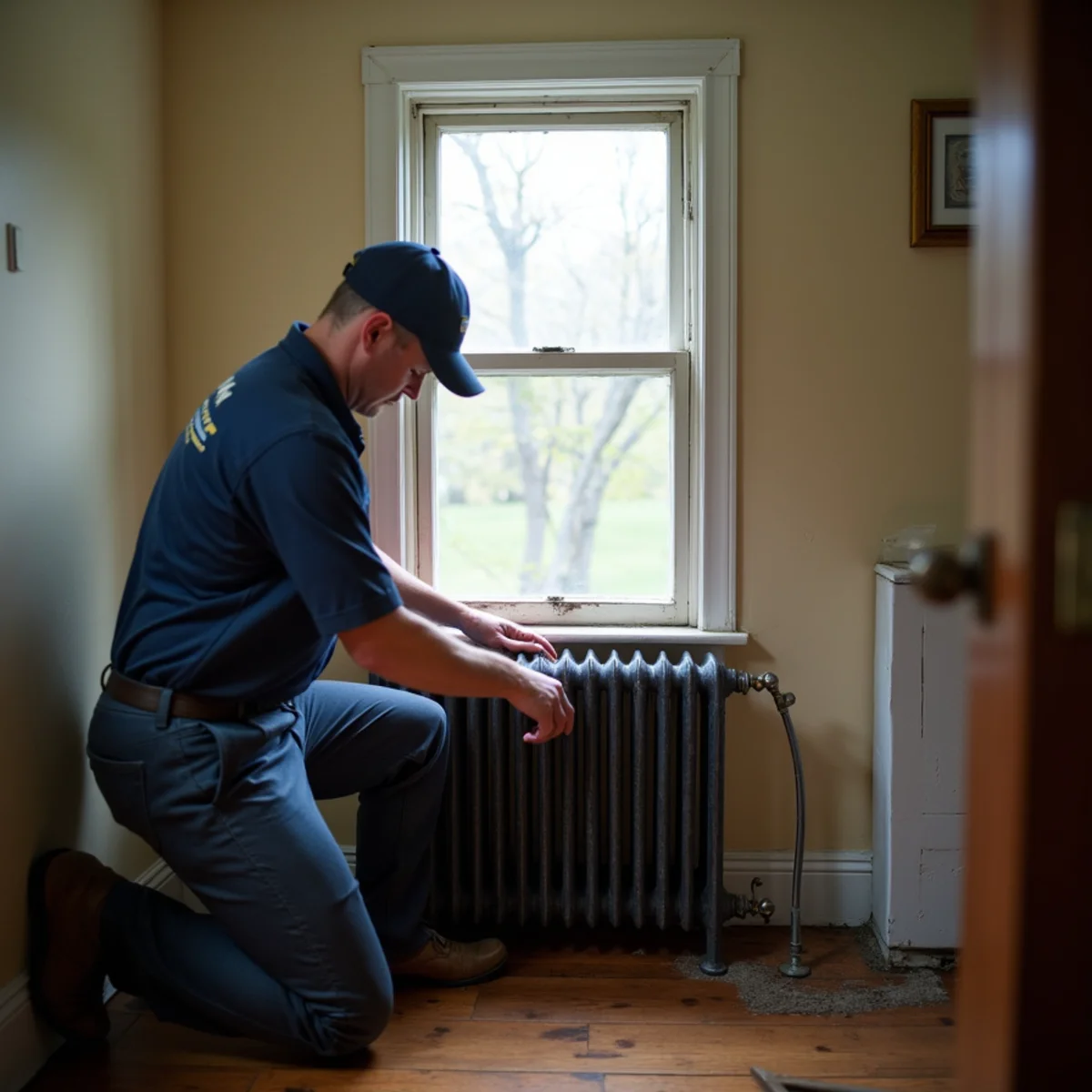
If your top-floor bedrooms roast while the living room stays chilly, your boiler is not broken — it is out of balance. Here is how radiator systems drift uneven in older Newburgh homes and what actually corrects it.
You crank the thermostat because the downstairs feels cold, and twenty minutes later the upstairs bedrooms are stifling while the living room still hasn't caught up. That daily tug-of-war is one of the most common calls we get from owners of older homes, and it almost never means the boiler is failing. It means the heat is not being shared evenly across the radiators — a balancing problem, not a breakdown.
Newburgh's housing stock is full of hot-water (hydronic) and steam systems installed decades ago and modified many times since. Radiators get swapped, pipes get capped during renovations, and thermostats end up on the one wall that heats fastest. The result is a system that technically works but distributes heat like a see-saw. The good news: most of it is correctable, and a lot of it you can start on yourself.
Why radiator heat runs uneven in older Newburgh homes
Heat naturally rises, so upper floors get a head start every time the boiler fires. On top of that basic physics, decades of small changes stack up. The radiator nearest the boiler on a single-pipe steam loop steals steam before the far-end units ever see it. A hot-water loop that was never re-balanced after a bathroom remodel now pushes most of its flow through the shortest path. Add a thermostat mounted in a sunny front room and the boiler shuts off before the back bedrooms are warm.
- Trapped air in hot-water radiators blocks circulation, leaving the top of the radiator or the last unit on the loop cold
- Steam radiators with a failed or clogged air vent can't push air out, so steam never fills them
- A single zone trying to heat three floors will always favor whichever level is closest to the boiler and highest in the building
- Furniture, long drapes, or radiator covers trapping heat against the wall instead of the room
- A shut or partially closed supply valve someone bumped years ago and forgot
- Thermostat placement in the warmest room, ending the cycle too early for the rest of the house
Fixes you can try before calling anyone
Bleed your hot-water radiators
If you have hot-water (not steam) radiators and the tops stay cold while the bottoms get hot, they're air-bound. Find the small bleed valve at the top of each radiator, hold a cup under it, and open it a quarter turn with a radiator key until air hisses out and a steady dribble of water appears, then close it. Start with the radiators farthest from the boiler and on the highest floor. Check your boiler's pressure gauge afterward — it should sit near 12 to 15 psi when cold, and you may need to top it up.
Check the vents on steam radiators
Steam radiators use an air vent on the side, not a bleed valve on top, and you should never open the valve on a steam unit while it's hot. A cold steam radiator usually has a stuck or clogged vent. Vents are inexpensive and matched by size — a faster vent on a far radiator and a slower one near the boiler is exactly how a steam system gets balanced. This is fiddly work, and getting the vent sizes right across the house is where a technician earns their fee.
Balance the valves
On a hot-water system, slightly throttling the supply valves on the radiators that overheat forces more flow toward the cold ones. Work in small steps over a few days — a quarter turn at a time — because the whole loop reacts to each change. Make sure every valve is either fully open or fully closed on a steam system, never partway, since a half-closed steam valve traps condensate and bangs.
Banging pipes are a warning, not a quirk
Loud hammering from steam pipes — water hammer — means condensate is trapped and slamming against the piping. Left alone it cracks fittings and can rupture a line. If your radiators knock hard when the heat comes on, shut the system down and book professional service before running it again.
When balancing needs a technician
If you've bled the radiators, replaced obvious vents, and the house is still fighting itself, the problem is deeper in the system. Persistent imbalance often traces back to an oversized or short-cycling boiler, a failing circulator pump on a hydronic loop, sludge and sediment restricting flow, or piping that was never pitched correctly for condensate to drain back. These are diagnosis jobs. Our boiler repair team in Newburgh tests circulation, pressure, and cycle timing across the whole system rather than chasing one cold radiator at a time.
We see this constantly in the tightly packed older homes of the West End neighborhood, where many houses share the same era of steam and hot-water heat and the same decades of ad-hoc modifications. A proper balance visit maps every radiator, checks vent sizing or valve settings against the system layout, and confirms the boiler is sized and cycling correctly for the load. Owners across the City and Town of Newburgh call us for this every heating season.
Sometimes the honest answer is that a decades-old boiler is short-cycling and no amount of balancing will fix comfort until it's addressed. If yours is loud, inefficient, or on its last legs, it's worth reading up on what a boiler replacement costs in Newburgh before winter deepens. But for most homes, balancing restores even heat without touching the boiler itself.
Keep the balance once you've found it
A balanced system drifts again if it isn't maintained. Air works back into hot-water loops over a season, vents wear out on steam systems, and sediment settles in the boiler. An annual service that includes bleeding, vent checks, and a pressure and circulation test keeps the whole house heating evenly instead of letting one floor bully the others. Regular hvac maintenance is far cheaper than a mid-January no-heat call when an unbalanced system finally gives up on the coldest night.
Need a hand from a local tech?
Call for same-day service across Newburgh and the Hudson Valley, or request a free written estimate.
HVAC Newburgh NY · 48 Carter St, Newburgh, NY 12550
Uneven radiator heat: symptom, likely cause, and first fix
| Symptom | Likely cause | First fix |
|---|---|---|
| Top of a hot-water radiator stays cold | Air trapped inside the radiator | Bleed it with a radiator key, farthest and highest units first |
| A whole steam radiator never heats | Stuck or clogged air vent | Clean or replace the vent, matching vent size to its spot on the loop |
| Rooms near the boiler roast, far rooms stay cold | Unbalanced flow or vent sizing | Throttle supply valves on the hot rooms; resize steam vents |
| Loud banging when the heat comes on | Trapped condensate (water hammer) | Shut the system down and book service before running it again |
| Upstairs overheats before downstairs warms | Thermostat in the warmest room, or one zone for the whole house | Relocate the thermostat or add zoning, then balance the loop |
| Heat evens out but drifts uneven again each winter | Air working back in, worn vents, sediment | Annual bleed, vent check, and a pressure and circulation test |
Frequently asked
Heat rises, so upper floors warm first, and a thermostat in a downstairs room keeps the boiler running until the upstairs overheats. Balancing the radiators — bleeding air, adjusting valves, or resizing steam vents — evens out the difference. If it persists, the boiler may be short-cycling or the circulation restricted.